
Regrowth
starts at the root.
Hair loss doesn’t begin on the surface — it begins at the follicle, millimetres beneath the skin, where topical products rarely reach. Velora is built around one peer-reviewed principle: deliver proven actives to the follicle, and you change the biology of growth itself.
Figures describe published research on the micro-infusion mechanism and the ingredient classes Velora uses — not trials of the Velora product itself. See references below.
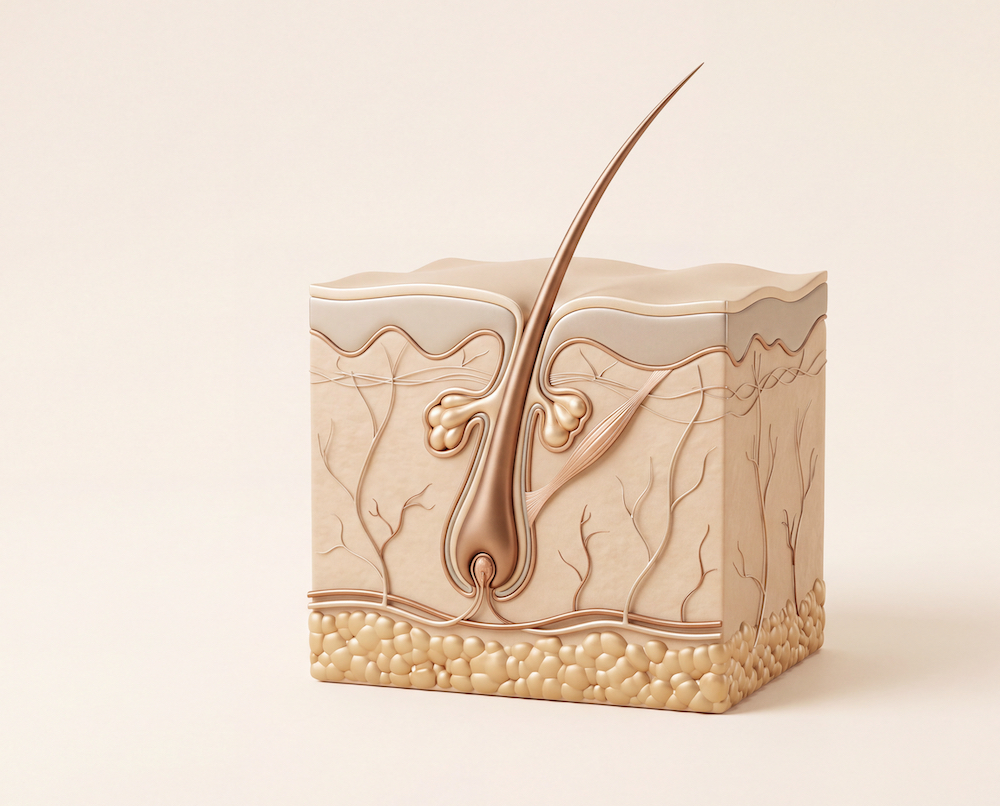
Your skin is designed to keep things out.
The stratum corneum — the scalp’s outermost layer — is a near-impermeable shield. It’s the reason most topical serums lose the majority of their active ingredient long before it reaches the follicle.
But the follicles themselves behave differently. Research shows they act as high-capacity “shunt” pathways — effectively open reservoirs that store and transport actives far deeper than the surrounding skin.2 In-vivo studies that tracked caffeine confirmed it reaches the follicle rapidly through exactly this route.3 The follicle isn’t just the problem — it’s the doorway.
Micro-infusion opens the channel — and the biology.
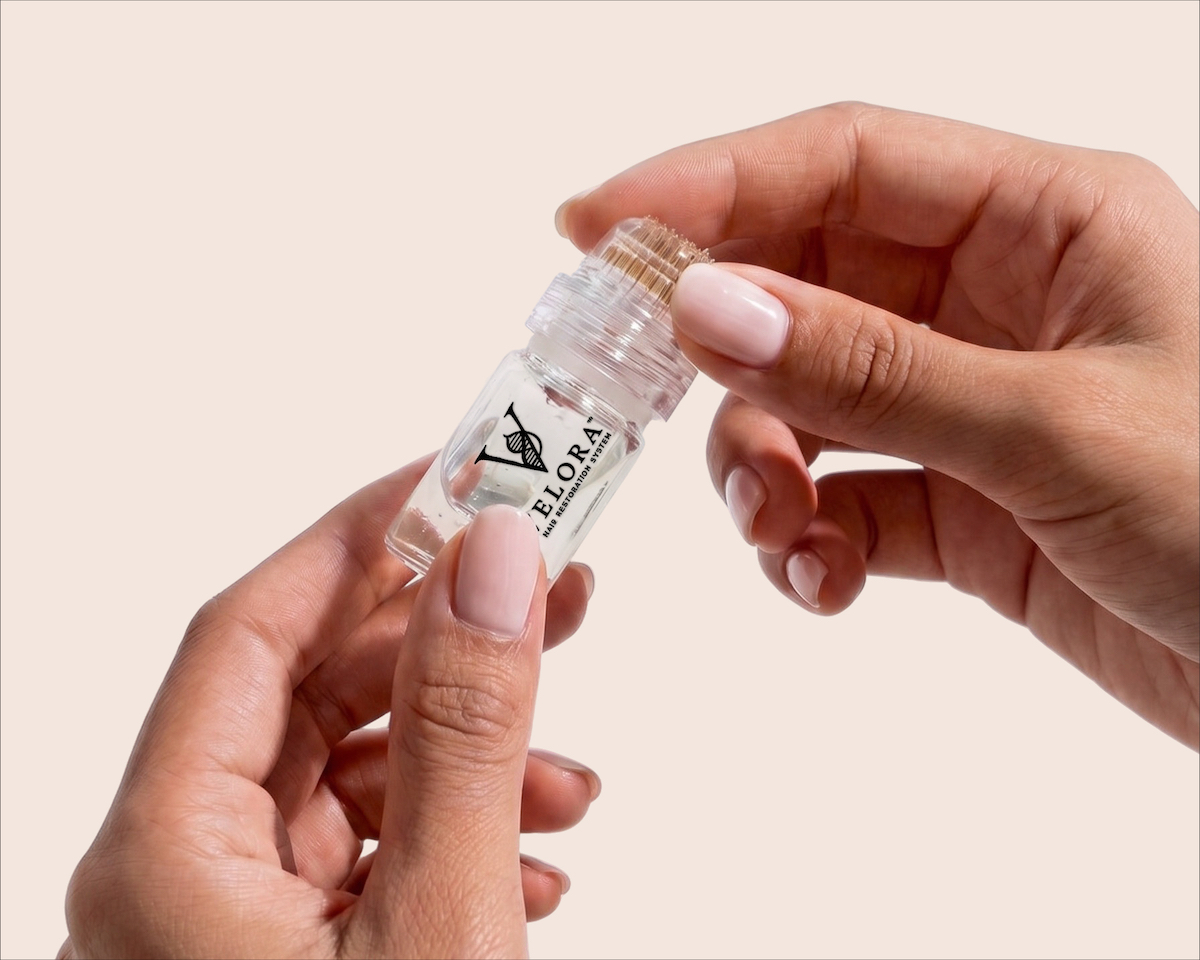
Velora’s applicator creates hundreds of ultra-fine micro-channels in the scalp. Two things happen at once.
-
Enhanced trans-barrier delivery
The channels bypass the stratum corneum, carrying the peptide serum directly into the follicular reservoir — a mechanism systematic reviews describe as markedly improved delivery of actives.4,9
-
Activated growth signalling
The controlled micro-injury triggers the body’s repair response, upregulating growth factors and Wnt/β-catenin signalling — the pathway linked to new hair growth in needling studies.1
-
Precise, comfortable, hygienic
Ultra-fine tips reach only the depth that matters — enough to open the pathway, gentle enough to feel like a scalp massage.
What the controlled data shows
In a randomized, evaluator-blinded trial, adding micro-needling to a standard topical regimen produced roughly four times the new-hair gain of the topical used alone over 12 weeks.1
Mean change in hair count at 12 weeks (Dhurat et al., 2013).1 A 2025 systematic review reached the same conclusion — micro-channelling enhances transdermal delivery and activates hair-follicle stem cells.9
Three ingredients, chosen for the evidence behind them
A delivery system is only as good as what it delivers. Velora’s serum is built on three actives with published, peer-reviewed support.
Adenosine
Shown in randomized trials to increase the ratio of thick, terminal hairs and improve global assessments in men,5 and over 12 months in women.6 It signals the dermal papilla to extend the anagen (active growth) phase.
Tsuboi et al., 2009; Oura et al., 2008
Caffeine
Human in-vivo studies show it penetrates rapidly through the follicular route,3 while in-vitro work found it counteracts testosterone-induced suppression of hair-follicle growth.7
Otberg et al., 2007; Fischer et al., 2007
Copper Peptides
In a randomized split-scalp trial, a GHK-Cu–based solution improved hair counts and shaft thickness over six months versus control8 — supporting the remodelling that micro-infusion helps activate.
Choi et al., 2016How micro-infusion compares
Every approach has trade-offs. Here’s an honest look at where micro-infusion fits.
Micro-Infusion
Minoxidil
Finasteride
Transplant
Your first 90 days
Regrowth follows the follicle’s own cycle. Consistency — twice a week — matters more than intensity.
The scalp settles
Reduced shedding as the follicular environment stabilizes and the serum begins working at the root.
Turnover & early vellus
Normal shed-and-regrow turnover, with the first fine (vellus) hairs starting to appear in thinning areas.
Visible density
The first clearly visible changes — the window most often reported in controlled micro-needling studies.1
Maturation
Vellus hairs mature into thicker terminal hairs; density compounds the longer the ritual is kept.
“Micro-infusion is one of the most effective ways to deliver active ingredients directly to the follicle — where real hair growth begins.”
Dr. Elena Marsh · Board-Certified Dermatologist- Dhurat R, et al. A randomized evaluator-blinded study of the effect of micro-needling in androgenetic alopecia. Int J Trichology. 2013.
- Lademann J, et al. Hair follicles as a target structure and reservoir for topically applied substances. Eur J Pharm Biopharm. 2006.
- Otberg N, et al. Follicular penetration of topically applied caffeine. Skin Pharmacol Physiol. 2007.
- Donnelly RF, et al. Microneedle-mediated transdermal and intradermal drug delivery. 2012.
- Tsuboi R, et al. Adenosine increases anagen hair in men with androgenetic alopecia (RCT). 2009.
- Oura H, et al. Adenosine for female pattern hair loss: 12-month evaluation. 2008.
- Fischer TW, et al. Effect of caffeine and testosterone on human hair follicles in vitro. Int J Dermatol. 2007.
- Choi Y, et al. Split-scalp trial of a GHK-Cu–based solution for hair growth. 2016.
- Ahmed A, et al. Systematic review: microneedling for transdermal delivery and follicle stem-cell activation. 2025.
- Irwig MS. Persistent sexual side effects associated with finasteride (observational). 2012.
These references describe peer-reviewed research on micro-infusion / micro-needling and the ingredient classes used in Velora — not clinical trials of the Velora system itself. Velora is a drug-free cosmetic device-and-serum system and is not intended to diagnose, treat, cure, or prevent any disease. Individual results vary. These statements have not been evaluated by the Food and Drug Administration. Consult a physician before beginning any new regimen if you have a medical condition.
Put the science to work.
Two minutes, twice a week. Backed by a 60-night guarantee.
Shop the System — $129